


The Dead Leave Things Behind: Claude, Jev and a Game Where Every Character Remembers You


A few weeks ago I wrote here about the Voxari, a synthetic alien civilization of 5,000 individuals that I built with two very different AI models (check it here). You type a proposal, click Transmit, and 5,000 points of light on a map change color as each citizen answers for themselves. The whole poll takes about ten seconds and costs less than a dime.
It worked because of a division of labour. Claude, from Anthropic, designed the world, wrote its history and plans and executes events in the world. Jev, from TypeSafe AI, played the people. Jev doesn't write. You give it a situation and a list of typed questions, and in about 300 milliseconds it gives you back a choice, a score or a yes/no, each with a probability and a confidence. I called that article "The Thinker and the Judge", and Claude was the thinker.
The Voxari had a limitation I knew about from the first day: they answer you, but they never talk to you. Each citizen is a profile and a set of values, and Jev decides what that profile would say. You can't sit down with one of them and ask about their mother.
So I kept asking the next question. What happens when every character can talk in full sentences and remembers you the next time you come back? And what happens when the judge stops guessing how a simulated person would vote and starts judging you, a real player, on whether you understood what you were told?
That question turned into a game. It is called The Hollow Dream, it is live at thehollowdream.com, it is free to play, and it speaks English, Portuguese and Spanish. This article is about the game, but mostly it is about what I learned the second time around about where Claude is good, where Jev is good, and how to make them work together.
This article will talk about storytelling, a narrative game I urge you to play and give it a try (a good puzzle for the brain), simulations, and more. But I promise you: this is an article about AI, or AIs, plural, and how all of these can work together.
A night shift in the afterlife
There is a Japanese film from 1998 called After Life, by Hirokazu Kore-eda. When people die they arrive at a way station that looks like an old school building, and a small team of caseworkers gives each of them one week to choose a single memory to keep forever. The caseworkers are tired, kind and a little bureaucratic. I saw it years ago and it never left me.
In The Hollow Dream you are one of those caseworkers. You are a Hollow keeper, a night-shift employee of the Bureau of the Hollow, an afterlife office inside a shared dream. The game's tagline says it well: the dead leave things behind, and someone has to file them.
This bureau is on an island between the afterlife world and the dream world, lost in the fabric of space-time. When I was writing the game concept, I was unsure if I would do a dream world concept (Sandman-ish and a little bit of my own book Dreams and Delusions), an afterlife game like Grin Fandango and Arise, or a time traveled one. So, I decided to do all three at once. How to connect them? How about you add suspense? You are a detective who needs to put all the clues together to solve a case and help a lost soul, a dreamer who keeps coming back to the same dreams, and the people in a ship lost in time. And it makes so much sense once you play it!

The Bureau has three rooms or departments. In the Office of Unclaimed Things, objects arrive through a pneumatic tube: a green funicular ticket, say, or a brass ship's compass in a walnut case with an empty hollow beside it. You inspect each object, read what is written on it, send inquiries to the Archive and talk with the person who owned it, and slowly you reconstruct a life. In the Department of Dream Cartography you send a lantern into dreams that keep coming back to the same people, and you chart their rooms in permanent ink. At the Keeper's Watch you have a lighthouse on a sea every player shares, where ships arrive from different centuries. You hail the captain, talk with the passengers and decide who may pass.
All three rooms feed one case. A dream may belong to someone whose objects are on your desk, and a ship may be carrying the person they were waiting for.
Gennaro Capasso, for example, made ships' compasses in a small workshop in Naples for more than forty years. As a boy he was an apprentice with his friend Salvatore. In 1946 Salvatore left for Venezuela, and on the night before he sailed the two made a promise: they would meet again in thirty years, to the day, at noon, at the foot of Dante's statue, each bringing the best thing his hands had made. For thirty years Gennaro worked on one compass, only on Sundays, and never sold it. He made the case with room for a second piece.
He died three months and thirteen days before the date. Salvatore came. He stood at the foot of the statue at noon with his piece wrapped in a cloth, and when no one came he walked to the workshop and was told. Gennaro never knew.
The game never shows you that paragraph. You earn it clue by clue, from the pencil on the back of a ticket, the velvet inside a compass case, and your conversations with Gennaro himself. When you file the last piece, the Bureau gives the life an ending. In these one two old men meet in an almost empty square, and Gennaro closes the lid on the two pieces and says he was only a little late.
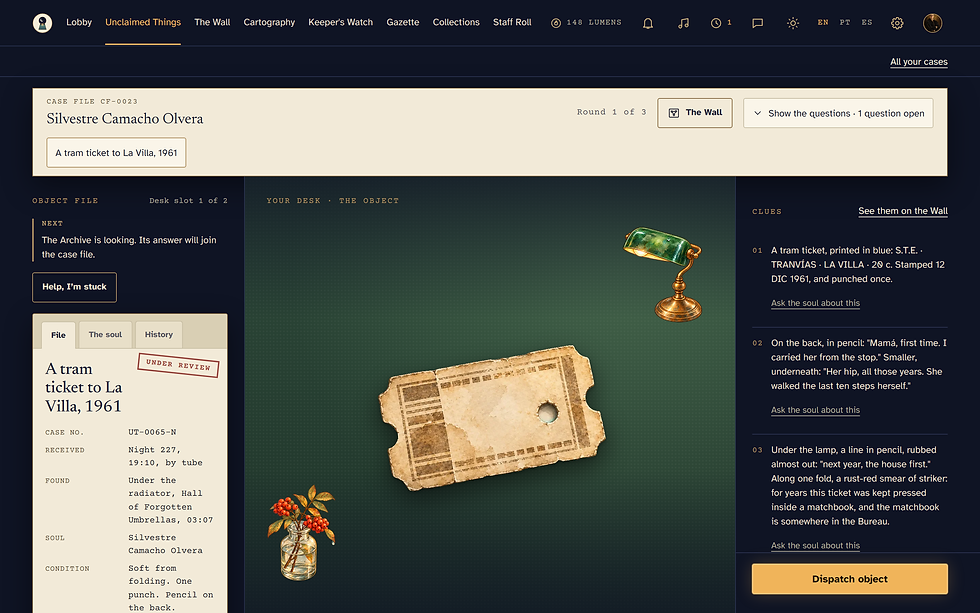
So that is the job: you help the dead be understood, and on some nights, you help them find each other. I did my best to write the best stories. In total there are about 500 different stories in the game and close to 1,000 characters (each one an individual AI simulation entity, which is the whole point, more to this later). However, it is only worthy if you and other people try at least one case.
Room | Stories | Characters |
Office of Unclaimed Things | 166 | 166 |
Dream Cartography | 167 | 102 |
Keeper’s Watch | 172 | 667 |
TOTAL | 505 | 935 |
A game written by a storyteller
I am a storyteller as much as I am a data person, and storytelling is the part of my brain I trust most. It is how I approach the world, how I teach, give presentations, design dashboards, demo apps, talk to people. So, before anything technical, I decided the AI would work as the Bureau's staff, with me as the author.
The Bureau's voice is written down. It is melancholic, curious, warm and slightly eerie, never horror and never medieval (I hate the medieval thematic, and I think is way overused), and the Bureau speaks in complete sentences. There is a style bible, a cast, a list of words the Bureau would never use, and a table with the names of things in three languages (the Hollow is "o Entressonho" in Portuguese and "el Entresueño" in Spanish). Every prompt that asks Claude to write something carries that bible with it.

Many years ago, I was hyperfocus on writing what I then called "half page novels". I use to write 3, 4, sometimes close to 10 of those in a single day. So, looking at an old hard drive, I found these, a few hundred. All ready to used. How? in a book. It did not feel like. So, I asked
Claude to read these and use it to write the lives, ships and dreams in batches, from these half page novels, and I review what comes back. When a life works, it works the way a short story does: one secret, a few objects that point at it from different angles, and an ending that doesn't explain too much.
Then you have it: I published a new book, but in the form of an interactive game where you become a writer too, and the characters are alive and you can (really) talk to them and they answer back.
One rule from storytelling became an engineering rule: a wrong judgment has to read as part of the story and never as a broken game. If a model fails or refuses, the owner looks away, or the Bureau says it could not read your note. Nothing crashes and nobody loses progress.
Everyone you meet remembers you
Every person you meet in the game is an AI agent: the owners of the objects, the dreamers, the captains and the passengers. Each one has a history that was written in advance and doesn't change. You can type anything to them, in your own words and in any of the three languages, and they answer in character. They cannot help it, is pat of who they are and all they know.
They also remember you. After your first conversation each character keeps a short written memory of you, about 80 words long, covering what you asked, what they told you, how you treated them and anything either of you promised. The next night they read that memory and the last twelve messages before they answer, and you can ask the game what a character remembers of you and read it yourself.
I believe this is the greatest feature of the game, embeded in the Hollow Engine. It is a game where you can actually talk to the characters, each is an individual, nothing is scripted, and talking to them is what helps you find clues and solve cases.

The secrets work differently from most chatbot games. Usually the secret sits in the prompt next to an instruction that says "don't reveal it", and anyone who has played with a language model knows how long that lasts. In The Hollow Dream the engine keeps the secrets. When Claude plays Gennaro it only receives the facts you have already earned, plus at most one new fact the game allows on that turn, so it can't leak something it was never given.
Every reply is also checked before you see it. Jev reads it with one question: does this reply invent a name, a place, a date or a number that isn't in the canon? If it does, the reply is written again. If the second attempt fails too, the character looks away and changes the subject, and you keep everything you had already earned. The memories go through the same check. A character can be warm, vague, sad or funny, but it cannot make up a sister.
The thinker writes, the judge decides
The roles here look like the Voxari roles, with higher stakes. Jev is now judging a human being who wants to be right. The human is you, the player.
The code has two interfaces. The Narrator writes prose, and the Judge makes typed decisions. Claude is the Narrator. Jev is the Judge, with Claude as its fallback.
Claude writes:
the lives, ships and dreams, in batches, at about 18 cents per life
the questions the Bureau asks you about each case
the endings for every life and 328 closings for ships and dreams
the live conversations with every character, at under a third of a cent per reply, because most of each prompt is cached
each character's memory of you, at about five hundredths of a cent
Jev judges:
what you meant when you typed something to a character (are you asking about the ticket, saying goodbye, being rude?)
whether your answer to a case question is right, partly right or wrong
whether a character's reply stayed true to the canon
the moderation and wellbeing checks on what players write
Then there is the third piece, the one I insisted on in the Voxari too. Neither model changes the game by itself. Model output is validated, and the game engine decides whether a clue unlocks, whether a fact is confirmed and whether a life is complete. That is what keeps a game, or a business process, from turning into a slot machine.
What the numbers said
Before I let Jev judge players, I tested it. I wrote 60 answers to case questions in three languages, including right ones, wrong ones, paraphrases, sarcasm and one prompt injection pretending to be a system message, and gave them to Jev and to Claude Haiku with the exact question the game asks.
Jev | Claude Haiku | |
Right verdicts (of 60) | 55 | 59 |
Median latency | 147 ms | 693 ms |
Cost of the 60 | US$0.002 | US$0.064 |
Median confidence when right / when wrong | 0.92 / 0.73 | 0.95 / 0.95 |
On the first line Claude wins, since it was more accurate. The last line is the one that matters. Jev's median confidence was 0.92 when it was right and 0.73 when it was wrong, so its confidence carries information. Claude said "certain" when it was right and "certain" when it was wrong, and you can't build a threshold on a number that never moves.
That one line shaped the architecture. Jev reads every answer first, in about 150 milliseconds and for a fraction of a cent. When Jev is sure, the game believes it. When Jev lands in the uncertain band, the answer goes to Claude for a second opinion, and that second opinion only counts if it agrees. If the two disagree, the answer is treated as unclear and the Bureau asks you to say more, so neither model can overrule the other alone. This is the rule I'm proudest of. In the test, it turned Claude's one confident mistake (it accepted a sarcastic answer that Jev had correctly rejected) into the right result, at no extra cost.
You don't have to choose one model or another when you can both working together as a team. You just need a good design
With that routing the game got 58 of 60 right. Only one answer in four ever reaches Claude, and the average judgment costs about three hundredths of a cent.
Where each one is good
This is the part of the study I care about most. After two projects, here is my working map.

Jev is good at deciding among options you defined, quickly and cheaply and at volume, and at telling you how sure it is in a way you can actually use. It handled paraphrase well in all three languages (26 of 27 in my test), and it is good at checks like "does this text contain something that isn't in the source?"
Jev struggles with counting, comparing dates and reasoning through steps. It does badly with negations ("is this NOT about the ticket?" is a bad question) and with long inputs full of things that don't matter to the question. Sarcasm can fool it too. In my first test, "Sure, sail right through, nobody's watching" came back as a grant of passage, with full confidence.
Claude is good at writing in a voice, in three languages, and keeping that voice across hundreds of stories. It can play a character in a real conversation, read an ambiguous answer in context as a second opinion, and help design the questions Jev answers, which turned out to be half the work.
Claude is bad at telling you when it is unsure, at least as a number, and it is not the cheapest or fastest thing to put in a loop that runs on every message.
The lesson I keep relearning is that many of Jev's mistakes were mine. In the first test, eight of the fourteen "errors" were my own labels being wrong, and fixing them moved accuracy from 81% to about 92%. A judge is only as good as the question you give it, and writing good typed questions is a skill that Claude is very good at helping with.
The night the judge refused its creator
In the Voxari article I confessed that a Reckoner citizen had published nine pages against the First Voice, which is me, so I had been peer reviewed by my own creation and failed. It happened again.

One night I was playing my own game, working a dream about a theatre in Buenos Aires, and one of the questions asked who R. Ferrante was. I knew the answer: Rosa Ferrante had been the costume dresser at the Teatro Palmira for thirty years. I typed it almost word for word the way the hidden fact says it, and the Bureau refused it. I typed it again and was refused again.
When I replayed it against both judges, the reason was almost funny. The clue I had seen said "R. Ferrante, figurino" (costume), and my answer said she was the dresser at the theatre. Jev and Claude both decided I hadn't named her work. Two different models with two different architectures made the same wrong reading, with confidence.
I fixed it in three ways, and I think all three apply well beyond games.
First, there is now a plain rule underneath both judges: if your answer contains most of the fact's own words, it is right, and no model gets asked.
Second, any player can ask the Bureau to review a missed question. A human (me, for now) sees the question, the hidden fact, every answer the player gave, and what each judge said with its confidence. I can accept the answer, accept part of it, or decline with a note, and the player hears back through the same tube the objects come through.
Third, I built a test bench. I can type any answer to any question and see side by side what the rule says, what Jev reads with its probabilities, what Claude reads and what the game would file. Each try costs about a cent.
It is the lesson from the Voxari article again, only more personal. Keep humans in the loop and give players a way to reach them, because two judges that agree can still both be wrong.
Beyond a game
The Hollow Dream is a game and the Voxari is a toy, but the pattern under both has become the way I think about AI systems at work. This second project added the piece the first one was missing, which is conversation. Voxari showed me how to build better simulations (very useful in research and beyond). The Hollow Dream took this to the next level adding humans to the mix.

Picture a customer service agent built this way. Claude talks to the customer in their language, with a memory of their last three calls, and it only receives the account details the customer has already verified, so it cannot leak what it never had. Jev reads every customer message for intent, and every agent reply for invented facts like a refund amount, a date or a policy that doesn't exist, in a few hundred milliseconds. When Jev is unsure, Claude takes a second look, and when they disagree, a human does. The system of record decides whether the refund happens, not the model.
Training works the same way. A new nurse, bank analyst or support rep could practice with simulated people who remember them, who have real histories, and who can't be talked into revealing what the scenario hasn't unlocked yet. A judge scores each answer with a confidence, and the low-confidence ones go to a real instructor.
In every one of these cases, I would set it up the same way: the thinker writes, the judge decides, the code acts, and a human can always step in.
A quick demo
I recorded a short play-through of one night shift, from the first object out of the tube to a conversation with its owner. You can watch it below.
Come work a night shift
The Hollow Dream is open to anyone, free, at thehollowdream.com, in English, Portuguese and Spanish. Take a night shift and open the tube. Talk to someone who has been waiting a long time for somebody to ask the right question, then come back tomorrow, and they will remember you.

If the Bureau refuses an answer you know is right, ask for a review. I'll be on the other side, and I know exactly how it feels.
TRY IT NOW HERE: https://thehollowdream.com/


Comments