


AI Art and the Punk Rock Response

Updated: Jun 11

Thirty thousand years ago, deep inside a cave in southern France, someone pressed a hand against a rock wall, put pigment in their mouth, and blew.
No audience. No gallery. No theory. No plan to monetize it later.
They did it anyway. And then someone else did it somewhere else. And then someone else, in Australia, in Indonesia, in South Africa, in Brazil. Different caves, different pigments, different hands, same impulse, across tens of thousands of years and every continent humans ever reached.
The handprints in the Chauvet Cave are roughly thirty thousand years old. They predate cities, agriculture, writing, and every institution we have since built to explain, protect, sell, and argue about the things humans make when they need to say I was here. In a sense, art predates History.
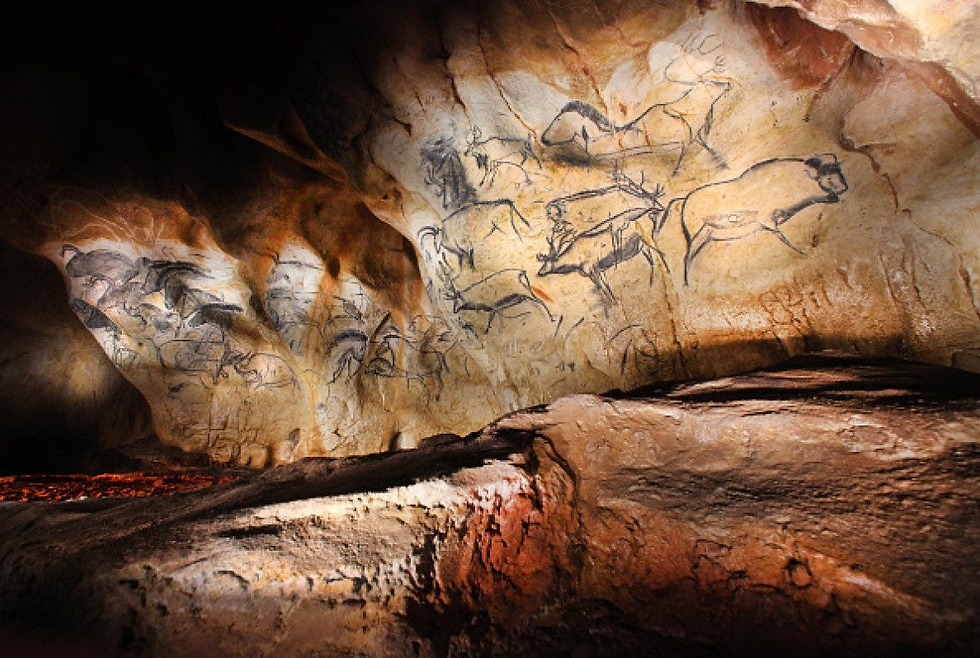
There is something worth noticing in the geography. The Chauvet Cave sits in the Ardèche, in southern France. Thirty thousand years later, in the same country, Louis Daguerre fixed the first photographic image onto a silver plate in Paris. The Louvre opened its doors on the banks of the Seine. The Impressionists gathered in Montmartre and decided that whatever the camera could do, they would do something else entirely. France managed to be the place where the oldest known human art was made (at least the oldest we could find), and then, millennia later, the very place where a machine first threatened to make human artistry redundant. What happened next was not the death of painting. It was the birth of modern art.
When in the Medical School, I took History of Art and some other classes in the university's art school. The very first question we were asked was: what is art? We are still arguing about what that means. We just have a new participant in the debate.
What We Talk About When We Talk About Art
The problem with the AI and art debate is that it assumes we've settled what art is. We haven't. The moment you try to define it precisely enough to test whether AI qualifies, the definition slips. It was never about the answer, but about the pursuit of a meaning.
Tolstoy, in 1897, wrote an entire book on this. His answer: art is the transmission of feeling from one human to another. Not decoration, not technique, not beauty. Feeling. If you make something and I don't feel what you felt, he'd say it failed. Almost biological in its simplicity. I personally disagree in a small detail: I don't have to feel the same Van Gogh felt when he painted the Starry Night, but when I saw it for the first time in New York, the paining where the universe itself was the muse of an art piece, I feel moved by tons of emotions and I cried. A lot. That is art to me.
Kant had a different answer. He argued that beauty is a judgment we make, not a property an object has. When you call a painting beautiful, you're saying something about your experience of it, not about the painting. The object doesn't contain beauty. You bring it.
Plato didn't like art at all. He thought it was imitation of imitation, a copy of the physical world, which was itself already a copy of the ideal world. Twice removed from truth. He would have banned artists from his Republic, which is philosophically fascinating and also proof that philosophers should not run governments. At least not Greek ones.
Aristotle disagreed, as Aristotle often did with his old teacher. Mimesis, the act of imitation, is how humans learn and make sense of experience. Art isn't deception. It's a way of thinking. We even have a whole form of art about imitation in theater.
Heidegger, in "The Origin of the Work of Art" (1935), took a different angle entirely. He argued that Art is how truth enters the world. Not representation, not decoration, not even expression. The painting of the Greek temple doesn't represent the temple; it opens up a world in which the temple can exist and mean something. Art is how a culture finds its ground. This is harder to dismiss than it sounds, and considerably harder to attribute to a language model predicting likely next tokens.
Nietzsche, decades earlier in "The Birth of Tragedy" (1872), had cut the problem differently. All great art lives in the tension between two forces he called the Apollonian and the Dionysian. Apollo brings form, reason, order, beauty. Dionysus brings chaos, intoxication, raw passion, and destruction. The best art holds both. Apollo gives it shape. Dionysus gives it blood. Yin and Yang for western culture.

If you follow Nietzsche, AI is pure Apollo. It can produce the form, the structure, the technical resolution. The question nobody has cleanly answered is whether it has any Dionysus in it at all.
They were all still debating it when Marcel Duchamp placed a urinal in a gallery in 1917, signed it "R. Mutt," and asked everyone to explain why that wasn't art. The art world has been in mild crisis ever since.
None of these definitions close the AI question. All of them make it more interesting.

The Museum Invents What Art Is Supposed to Be
For most of human history, "art" didn't exist as a separate category. There was sacred painting, decorative craft, court portraiture, church mosaic, temple sculpture. Objects with purposes. A fresco on a cathedral ceiling wasn't there to be contemplated. It was there to remind parishioners who couldn't read what happened to people who made bad choices. It was an educational comic book of their time.
The idea of art as a standalone thing, made purely for aesthetic experience and displayed for public contemplation, is recent. Post-French-Revolution recent.
The Louvre opened as a public museum in 1793. The royal collection, stripped from Versailles, was put on display for citizens. It was a political act before it was a cultural one. These objects, previously reserved for kings, now belonged in theory to everyone. The museum was a declaration of ownership. Not yours personally, but ours.
Through the 19th century, museums standardized what counted. Walking through rooms of labeled, dated, attributed work, a canon formed. Some art was "important." Some was not. Institutions decided, and the decision hardened into stone buildings with marble floors and school field trips. I love the work of Jean-Michel Basquiat, but we only talking about him today because some gallerist in New York and Andy Walhol decided that he was worthy.
Pierre Bourdieu, in "Distinction" (1979), made the uncomfortable argument that taste is not really aesthetic at all. It is social. What you find beautiful is almost entirely predicted by your class background, your education, your accumulated cultural capital. The museum doesn't just house art. It reproduces the social order by making certain tastes feel natural and others feel provincial (I always wanted to use this word. Now I can sound educated :D). You don't just visit the Louvre. You learn who you are supposed to be in relation to it. Same applies to many other things, like wine and culinary.
Arthur Danto pushed the institutional logic to its limit. In "The Artworld" (1964), he argued that what makes something art is not any property of the object itself but whether the artworld, the network of artists, critics, curators, historians, and institutions, decides to treat it as art. Duchamp's urinal was not art when it sat in a plumbing supply shop. It became art when it entered the institutional frame. The frame is the thing. Which is either reassuring or terrifying, depending on whether you think the artworld is making good decisions.
Then the 20th century White Cube gallery did something stranger: it removed all context. White walls, no furniture, no explanatory plaques. The object alone. This made art about the viewer's experience in a way the Louvre never intended. You stood in front of a Rothko color field and either something happened to you or it didn't, and neither answer was wrong.

Walter Benjamin saw the deeper problem in 1935. In "The Work of Art in the Age of Mechanical Reproduction," he wrote about aura, the quality an original work carries because it exists in a specific place, at a specific moment, touched by a specific human hand. A perfect photographic reproduction of the Mona Lisa is technically complete. However, something is still gone.
The museum has always been, among other things, in the business of protecting aura. That's what the climate-controlled rooms and the velvet ropes are really for.
AI produces work with no original, no author's hand, no particular morning it was made. No aura in Benjamin's sense. The museum built to protect aura doesn't quite know what to do with that yet. But it's figuring it out faster than most people expected.
Everything Was Already Hamlet (Including the Beatles)
Before we get to AI and originality, we should be honest about human originality first. The case is weaker than we like to admit.
The Lion King is Hamlet. Breaking Bad is Macbeth. The Matrix is Plato's Allegory of the Cave in a leather jacket and Goth. Star Wars is Joseph Campbell's Hero's Journey filtered through Akira Kurosawa. I have discussed this in all of my Storytelling workshops and presentations. Every four-chord pop song since roughly 1960 shares the same skeleton. Harold Bloom called this the "anxiety of influence. "Every artist is haunted by the artists who came before, and creating is partly the act of wrestling free from them".
T.S. Eliot put it more bluntly in 1919: "Immature poets imitate; mature poets steal." He meant it as a compliment. Taking something and making it yours so completely that the source disappears is a higher skill than pure invention. Which may not really exist anyway.
The Beatles, the greatest and most influencial rock band of all time (no debate here) are the clearest example of how this process actually works, and also the most instructive for where we are now.
In 1963, the Beatles were a very good cover band. Chuck Berry guitar licks, Little Richard energy, Buddy Holly structures. They absorbed American R&B and played it back with Liverpool accents to teenagers who had never heard the originals. Nothing they were doing was new in any strict sense.
Then something shifted. Rubber Soul (first time eastern instruments were used in western pop music) in 1965. Revolver (my favorite one) in 1966. Sgt. Pepper in 1967. The White Album (that really does not have that name), the very first double feature record, in 1968. By Abbey Road in 1969, you were listening to something that could not be traced cleanly back to its sources. By the end, Helter Skelter was closer to Led Zeppelin than it was to Love me Do. The technique was still borrowed. The combination was entirely theirs.
What happened? They became themselves. They brought what they'd lived, what they feared, what they needed to say. The recombination became personal. That's what made it feel new.

Can AI become itself in that way? Margaret Boden, the cognitive scientist who has spent decades studying machine creativity, distinguishes three types of creative act: combinational (new connections between familiar ideas), exploratory (pushing a known style to its edges), and transformational (breaking the frame so completely that an entirely new conceptual space opens up). The Beatles' early work was combinational. Revolver was exploratory. "Revolution 9" was transformational.
Boden's research suggests AI handles combinational creativity well and exploratory creativity adequately. Transformational creativity, the kind that requires breaking the rules rather than working within them, is where things get genuinely uncertain. Whether it can bring something personal to the combination, whether it has a self to bring at all, nobody has answered cleanly yet.
Revolution 9 and the Sound of Someone Refusing
Here's what happened at the end of that same decade. By 1968, pop music had become a machine. It produced reliable three-minute singles, radio-tested and structurally predictable. The formula worked and the formula was everywhere.
The avant-garde had been warning about this for years. In 1952, John Cage sat at a piano, opened the lid, and played nothing for four minutes and thirty-three seconds. The piece is called "4'33"." The audience heard ambient sound, shuffling, birdsong outside, their own discomfort. Cage's point was that music is not what the performer plays. It is what the listener hears. Silence, framed as performance, becomes music. The frame is the composition.
John Lennon knew about Cage. Yoko Ono came directly from that world. And so, sixteen years after "4'33"," they put "Revolution 9" on the White Album. Which was only possible because now the Beatles own their record label, Apple Records.
Eight minutes and twenty-two seconds of tape loops, backwards recordings, crowd noise, glass breaking, piano fragments, and a voice repeating "number nine, number nine, number nine" until the phrase loses all meaning. It is not a song. It is barely music by any conventional measure. It sits on one of the most commercially successful albums in history as a deliberate provocation against everything around it.
Why? Because when everything sounds the same, the most interesting response is to make something that sounds like nothing anyone agreed to. That not even sounded like music. It was not just a song, but a manifesto to the artists out there. "Hey, if the greatest band ever can do it, why can't we?"
Yoko Ono's role here is worth naming directly, because it gets underestimated. She came from Fluxus, the avant-garde movement where the question "is this art?" was itself the point of the work. She brought that into the most famous band in the world. The result was eight minutes of the Beatles refusing to be the Beatles.
That refusal was a position. It said something about the moment, about John's state of mind, about where pop music had arrived and what might be on the other side, that a well-crafted single simply could not.
The AI art debate needs that refusal. Not as a permanent answer, but as a reminder that when technique becomes cheap and ubiquitous, the most radical move is sometimes to reject what everyone else is optimizing for.
The Camera Didn't Kill the Painter
When photography arrived in 1839, Paul Delaroche stood in front of a daguerreotype and said "from today, painting is dead."

He was a reasonable man making a rational observation. The camera did what painters had spent centuries training to do, capture reality, faster, cheaper, and more accurately than any human hand. If the purpose of a portrait was accurate documentation, the portrait painter's career was over.
He was wrong. Painting didn't die. It had a crisis and came out the other side as something nobody had asked for and everyone needed. Just like Cinema did not kill theater.
Susan Sontag, in "On Photography" (1977), a book as old as myself, made the deeper point: photography didn't just replace a function. It changed how humans see. The camera taught the eye to look for composition, for decisive moments, for the telling detail that contains a whole story. We now perceive the world partly through the visual grammar photography invented. The machine didn't just produce new art. It produced new humans.
Artists did not see photography as a threat, but as freedom. The Impressionists said: fine, let the camera have accuracy. We'll paint light. The Expressionists said: forget the subject, we'll paint emotions. The Surrealists abandoned the waking world entirely. Each generation, pushed out of the territory the machine had claimed, went somewhere stranger and more personal.
The same pattern appeared in music a century later. When 1970s rock became overproduced, stadium tours, concept albums, guitar solos that lasted longer than some marriages, punk arrived as a deliberate rejection of all of it.
Three chords. A scream. A photocopied flyer stapled to a telephone pole. Hey Go, let's go! Anarchy in the Art!
The Ramones, The Clash, the Sex Pistols. They were not trying to be better than prog rock at prog rock's own game. They were making a different argument entirely: that technical accomplishment had become the problem, not the solution. DIY wasn't a workaround. It was the message. The Sex Pistols allegedly fired their first guitarist because he was too good.
Anyone can do this. You don't need a record deal or a producer or ten years of lessons. You need something to say and the nerve to say it badly in public until you get better or stop caring about getting better. That's how I started in music, in Brasília 1991 singing and playing for a band called PCO before I was any good at doing and playing music. I only studied violin and theory a year later.
That ethos produced some of the most vital music of the 20th century. Not despite the rawness. Because of it.
Three Chords and an Algorithm
Now here is where it gets strange, because AI has done something to the creative world that rhymes with punk in a way nobody planned.
Punk said: you don't need technique to make something real. Three chords is enough.
AI says: you don't need technique either. Describe what you want and the machine handles the rest.
Both are democratizations. Both remove the technical barrier between the person with something to say and the act of saying it. The difference is direction. Punk removed the barrier by arguing technique wasn't necessary. AI removes it by doing the technique for you.

You don't need to know how to paint to produce an image now. You don't need music theory to compose. You don't need to understand perspective, color theory, narrative structure, or any of the vocabulary that centuries of art education were designed to transmit. Type a sentence. Get a painting.
This is either thrilling or deeply disturbing, depending on what you believed the point of art is. If you thought it was a gate, a credential, a years-long initiation that earned you the right to call yourself an artist, then yes, the gate is gone. If you thought it was a means to an end, a way of building vocabulary so you could say what you actually wanted to say, then AI just handed that vocabulary to everyone, for free. Or for a cost of a few tokens.
There is research that supports the intuition behind this. Studies on how people experience AI-generated art consistently find that attribution changes everything. In a 2018 study, participants rated works as less moving and less valuable when told they were algorithmically produced, even in cases where they could not tell the difference blindly. The knowledge that no human felt anything while making the work affects the experience of looking at it. This is Benjamin's aura, but measured and documented.
The punk response to this moment might be: refuse the algorithm. Make something so specific, so stubbornly human in its imperfections, that no model trained on aesthetic consensus would produce it. Not better. Weirder. More yours.
Angine de Poitrine, the Montreal band, sounds like that choice being made in real time. You don't make music that deliberately strange by accident. It's a position. It says: this is not what the machine would do, and that is exactly the point.
Revolution 9, in other words, is always available as an option. The question is who has the nerve to choose it.
The AI Art Museum Is Already Being Built
The museum is the institution that decides what counts. So, what happens when AI art walks through the door?
Refik Anadol's "Unsupervised" ran at MoMA in 2023, an AI system trained on the museum's own collection, generating shifting visual interpretations of it in real time. MoMA didn't tolerate the work. They headlined it. Visitors lined up.
In 2018, Christie's sold an AI-generated portrait called "Edmond de Belamy" for $432,500. The work was made by the French collective Obvious. Where the artist's name would normally go, they printed the algorithm's loss function: min G max D, a line of code instead of a signature. The auction house, the price, and the location of that signature were all making arguments at once.
A dedicated AI Art museum is coming. The questions it raises are ones the institution was never built to answer.
Who is the artist? The person who wrote the prompt? The team that trained the model? The company that owns the infrastructure? When there is no original, what does the museum preserve? When there is no scarcity, what creates value?
Photography forced similar questions and the answer that eventually held was: credit the photographer, not the camera. We value the eye, the decision, the moment chosen. Henri Cartier-Bresson's idea of the "decisive moment" was never about the camera. It was about Cartier-Bresson knowing exactly when to press the shutter.
Maybe AI art works the same way, and the artist is whoever made the meaningful choices. Or maybe it works more like industrial design, where authorship is distributed across a team and what matters is the object, not any single hand. Dieter Rams didn't sign every Braun product. We still talk about Dieter Rams.
What the AI Art museum cannot exhibit is Benjamin's aura. You can show the output. You cannot show the human presence behind it, because there isn't one. Whether visitors will care, whether that absence changes how they feel standing in front of the work, is an open question.
My guess is that some people will care enormously, and others won't at all, and the split will tell us more about those people than about the art.
The Cave Painting Answer
Back to the Chauvet Cave. Back to the handprint.
Thirty thousand years ago. No audience, no institution, no theory of what art is supposed to do. No anxiety of influence because there was no established tradition to be anxious about. Just a person, a wall, pigment, and something they needed to do badly enough to do it in the dark.
We don't know exactly why. The guesses range from ritual to record-keeping to something we have no word for because we are too far removed from the context. But humans did this repeatedly, in caves across every continent, across tens of thousands of years, for reasons that had nothing to do with survival or any of the things biology is supposed to care about.
Ellen Dissanayake, in "Homo Aestheticus" (1992), made the evolutionary argument for why this keeps happening. Art-making is not a cultural invention or a luxury behavior. It is biological. She called the underlying drive "making special", the human compulsion to mark certain objects, moments, and experiences as set apart from the ordinary, as significant, as worth attending to. Every culture that has ever been studied does this. None have been found without it. It is an inner desire of survive after your body is under ground. To be remembered. The shellfish gene all over it.
Denis Dutton, in "The Art Instinct" (2009), pushed the evolutionary case further. Art, he argued, is a fitness display, a demonstration of skill, imagination, and cognitive flexibility that signals something important about the person making it. This sounds reductive until you realize it makes art as fundamental to human nature as any other evolved behavior. Not a decoration on top of being human. Part of what being human is.
Neuroscience has started to map where this lands in the brain. Research by Ed Vessel at New York University found that deeply moving art activates the default mode network, the system normally associated with self-reflection, personal memory, and imagining future scenarios. When a piece of music gives you chills or a painting stops you cold, it is not some separate aesthetic faculty lighting up. It is the part of your brain that processes your own identity and your place in time. Art doesn't just please you. At its strongest, it temporarily merges with how you understand yourself.
That is not something you replicate by improving the training data.
The need to make art appears to be older than civilization. Older than agriculture. Possibly running alongside language since before we could write either one down.
History keeps making the same point: every time a technology made something faster or more accurate, humans found new reasons to do it slowly and personally. Synthesizers didn't kill guitarists. Cinema didn't kill theater. Photography didn't kill painting. It freed painting from the obligation of accuracy and pointed it somewhere more interesting. Punk didn't kill music. It saved it, briefly, from its own comfort.
AI will not kill art. It will probably push human art somewhere it wouldn't have found otherwise. Somewhere stranger. More uncomfortable. More interested in the specific and the imperfect and the inexplicably personal.
More interested, in other words, in the handprint than the reproduction.

So, What Are You Going to Make?
Delaroche said painting was dead in 1839. John Lennon put "Revolution 9" on the White Album in 1968. The Ramones played their first show at CBGB in 1974. Someone pressed their hand against the wall of the Chauvet Cave thirty thousand years ago.
None of them knew what would come next. All of them made something anyway.
You now have tools that would have been unimaginable to any of them. You can generate images, compose music, write prose, produce films, all without mastering the techniques those things required for centuries. The algorithm handles the technique. The barrier is gone.
The question is not whether that counts as art.
The question is: what do you have to say that is too strange, too specific, too stubbornly yours for any model trained on consensus to have guessed it?
That thing is still waiting. The wall is right there.
Author: Igor Alcantara


Comments