


The Jet Age of Consulting: How AI Is Breaking the Hourly Model


You know that scene in every heist movie where the genius safecracker sits down, cracks his knuckles, and spends twenty tense minutes with his ear to the vault, listening for each tumbler to fall into place? The whole sequence exists so you understand something: this person is extraordinarily skilled, this takes time, and that time is the proof of the value.
Now imagine someone slides a machine under the vault door that opens it in thirty seconds.
The money inside didn't get smaller. But the safecracker's invoice just did.
A Problem Disguised as Progress
Professional services companies (consultants, lawyers, accountants, analysts, the whole lot) are staring at a version of this problem right now, and most of them are still deciding whether to panic or pretend it isn't happening.
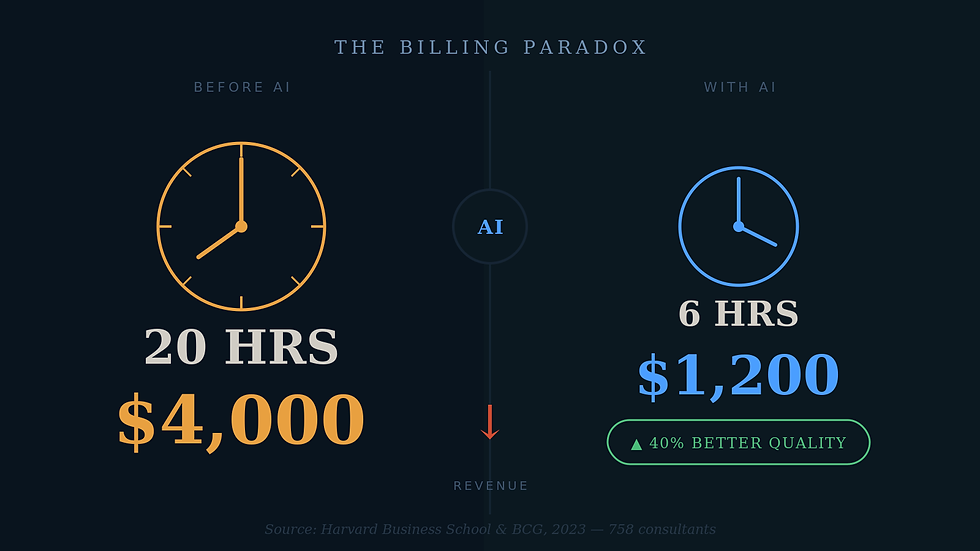
Here's the paradox. AI tools, specifically large language models and AI-powered workflows and agents, are making knowledge workers dramatically faster and, in many cases, measurably better. In 2023, Harvard Business School and the consulting firm BCG ran a controlled experiment with 758 BCG consultants to test exactly how much. The group with access to GPT-4 completed tasks 25% faster, produced work rated 40% higher in quality, and finished 12.2% more tasks than the control group without AI. Junior consultants improved the most, by 43%. Even senior consultants got a 17% performance boost on tasks within AI's range.
That's an extraordinary finding. It's also, from a revenue standpoint, somewhat alarming.
A consultant who used to spend 20 hours creating a data model can now do it in 6. At a rate of $200 per hour, that's $4,000 down to $1,200. The work quality went up. The delivery time went down. The invoice shrank. Meanwhile, the AI subscriptions, infrastructure, and tooling cost real money every month regardless of how many projects come in. A small consulting firm running a handful of AI tools across a team of ten can easily spend $2,000 to $5,000 a month before a single invoice goes out.
McKinsey's own internal AI tool, Lilli, is now used by 70% of the firm's employees, handling about half a million queries a month and saving consultants roughly 30% of their time on research and synthesis. BCG's research puts the average time savings from generative AI at about five hours a week per knowledge worker.
Five hours a week, per person, at consulting rates. Do the math. Then try not to panic.
The Second Hit
There's also a second, subtler pressure beyond the invoice: clients who know you're using AI will start to wonder why they're paying the same rates. They don't always say it, but the question is floating in the room.
"If a machine did half of this, why does my invoice look the same?"
Here's the thing: 73% of consulting clients now say they prefer pricing models tied to measurable business outcomes rather than time spent. That number should make every time-and-materials contract feel slightly unstable. Clients aren't just asking the question internally anymore.
And the legal world, which arguably has more skin in this game than anyone, is already seeing the cracks. Legal AI use grew 315% from 2023 to 2024. More than half of legal professionals now expect AI to directly impact the prevalence of the billable hour. The average lawyer currently records only 2.9 billable hours in an eight-hour workday (I know, shocking and unsurprising at the same time). AI could change that number dramatically, but not without a business model rethink to go along with it.
Both pressures are real. And they're not going away.
The Airplane Didn't Make Travel Cheaper
There is an analogy I find useful here and I am using it a lot (and no, I'm not about to tell you to "think like a startup" or any equally weak and hollow advice).
When commercial air travel took off in the 1950s and 60s, it compressed time in a way nothing had before. A trip from New York to London that used to take five days by ship now took seven hours. Some people expected the cost to collapse, because it felt like less was being consumed: less time, less of your life, less waiting.
It didn't work that way.
Flying was, for a long time, more expensive than sailing. The reason was obvious once you stopped just thinking about time: the value being sold was not the hours in transit. It was the arrival. Getting to London on Tuesday instead of Sunday was worth real money on its own. The speed itself was the product.
Airlines didn't say "we cut your travel time by 80%, so here's an 80% discount." They said "we can get you there in time for your Wednesday board meeting, which otherwise wouldn't have happened." Entirely different conversation. Entirely different price. In the same way, faster Internet or faster cars are not cheaper.
AI is the jet engine of knowledge work. It compresses time dramatically. The question every consultant needs to answer is the same one the airlines answered sixty years ago:
Are you selling hours, or are you selling arrival?
What You're Actually Selling?
Here's an uncomfortable truth that AI is making impossible to ignore: most consultants were never really selling their time. If they were, why some were more expensive than others? They're not taxi drivers, they're football players. They were selling judgment, relationships, accountability, experience, and the ability to translate complexity into decisions. The hours were just how they counted it.
A lawyer who takes three hours to review a contract isn't selling 180 minutes of legal reading. They're selling the confidence that if something in that contract will cause trouble in two years, someone with experience and professional liability will catch it now. The time was always a proxy for something else.
AI removes the proxy. Now the judgment has to stand on its own. The deliverable is the same. The conversation, not.
This is actually good news, but it requires a different kind of courage than most professionals were trained for. It means going to a client and saying: "I can solve this problem in two days. It used to take two weeks. I'm not charging less, because the problem is the same size, the risk is the same size, and my expertise is what makes this possible at all."
Some clients will push back. The ones who understand the game and are getting ready for the future won't.
Of course, it goes without saying that AI should not do the whole job. The human side is always responsible for the deliverable, otherwise terrible outcomes will definitely happen. Carrers, reputations and lives could be gone, people could go to jail. It is not AI replacing humans, but AI enhancing humans.
Three Ways Out
Working in consulting myself, this is something that keeps me up at night. As a leader at IPC Global, I have been reading and thinking a lot about this very topic. The consulting world doesn't need to rebuild its business model overnight. But there are three directions that hold up when you think them through.
Outcome-based pricing
This is the one everyone says they're doing and very few actually do. Outcome-based pricing means you charge for the result: the acquisition integrated, the audit passed, the system deployed, the strategy approved by the board. The scope is defined, the price is fixed, and how long it takes you internally is your business.
The incentive flips completely. If AI helps you deliver in half the time, your effective hourly rate just doubled. That's a much healthier dynamic than hoping clients don't notice. However, this also involves better requirement gathering, and world class project management. Spend more time planning, less building.
The big firms are already moving this way. McKinsey claims that now they generate roughly 25% of their global fees from outcome-based arrangements, up from nearly nothing five years ago. BCG expects AI-related work to represent about 40% of its revenue by the end of this year. When firms that size make that kind of structural bet, that tells you something.
The biggest challenge is that it requires a much clearer definition of scope upfront, the client needs to agree on what done actually looks like, and you need the confidence to defend your price when they do the time math. Not every engagement works this way, but more of them do than most firms are willing to admit.
Leveraged capacity
Here's one thing AI can't replicate in the short term: a trusted human who understands your industry's politics and can walk into a room of skeptical executives and move them. Someone who can make things happen, drive adoption, lead with example and charisma. That's a rare and expensive asset.
What AI can do is absorb the volume work that used to require a small army of junior staff. Research, first drafts, data synthesis, summarization, compliance checks: all of this is now dramatically faster. That frees senior practitioners to focus on the work that actually requires them, and it changes the staffing model.
The bad news, for now, is for junior people, those who just came out of college. Some of them say it's hard to find a job. That is one of the reasons they're so resistant to the AI revolution. I think the companies that do that, replace future talents with AI, are making a big mistake. This is the generation who will be the best at AI, who will leverage its capabilities and understand their limitations the best. Like Millenniums and the Internet. However, this is a conversation for another article.

The firms that adapt fastest will use AI to push senior talent upstream. Less time on production, more time on strategy, relationships, and the decisions only a seasoned human can navigate. Less assembly line, more boardroom.
A concrete example: at IPC Global, our teams are now able to migrate entire Qlik infrastructures from on-premise to Qlik Cloud up to ten times faster than before, using MCP integrations and AI-assisted workflows alongside the Qlik Cloud APIs. Projects that used to require months of careful, manual migration work now take days. More importantly, some engagements that were previously considered too complex or too costly to even attempt are now viable. That's not a productivity improvement. That's a category shift. The client isn't getting the same thing faster; they're getting something they couldn't have had before. That's a completely different conversation.
Retained expertise
The retainer model has existed in law and PR forever, but it's stayed niche in management consulting and technical services. AI changes the economics here.
If a client can access your expertise on demand via a structured retainer, getting quick answers to the questions that keep coming up between projects, the value is high and the delivery cost is now far lower than it used to be. You serve more clients at a higher quality level without cloning yourself. Some consulting firms are already running subscription-based models that bundle AI tool access with consultant hours and usage-based billing for heavier work. Worth watching how quick this is going and the effect in the consulting economy.
The shift is moving from "someone the client hires for a project" to "a thinking partner they keep around because the cost of not having you is higher than your retainer." A very different relationship. A much stickier one. A new Customers for Life approach.
One More Thing the BCG Study Found
I want to come back to the Harvard and BCG experiment for a second, because there's a finding in it that tends to get less attention than the headline numbers.
They called it the "jagged technological frontier." AI makes you significantly better at tasks that fall within its capabilities. But for tasks outside that range, consultants using AI actually made more errors than those without it, by 19 percentage points. The tool was so fluent, so confident, so convincing, that people stopped verifying. They outsourced judgment to something that doesn't have any. They trust human responsability to something that was not human at all.

This matters a lot for professional services, where the liability sits with the professional, not the model. The AI doesn't carry malpractice insurance. The attorney, the auditor, the analyst: they still do. Speed without review isn't an upgrade. It's just a faster way to make a confident mistake. That is a disaster waiting to happen.
So yes, AI reduces delivery time. It does not reduce responsibility.
What This Requires From You
None of this is purely structural. A lot of it is psychological.
The hourly model, whatever its flaws, offers a certain kind of comfort. You know what you're selling. The client knows what they're buying. The invoice is a simple multiplication. No ambiguity, very little vulnerability.
Outcome-based and retainer-based models require you to make a claim: "I am worth this." Not "I spent these many hours." Just: "I am worth this." That's a harder sentence to say, and a harder one to defend in a negotiation, because you can't point to a timesheet. You have to point to yourself. Tom Brady did not make millions because he played more snaps, he won millions because he was the best and made his teams win.

That shift also means a willingness to lose clients who were only ever buying your time. Some of those relationships were more transactional than you may have noticed. Not at first, but clients who do not shift conversation might find themselves being not the priority anymore. I believe that every client is important and all of their problems are a priority. We are always willing to meet the customer where they are more confortable. However, times like these involve having difficult conversations. The companies who will survive the ones that understand the new world we are living and are capable of change.
There's also a harder version of this conversation, and it's about skills, not pricing.
AI doesn't just change what you charge. It changes who is valuable. For a long time, tech and consulting ran on a relatively simple hierarchy: the person who could produce the most output fastest was near the top. The developer who wrote the most code. The analyst who turned around the most reports. That era is quietly ending.
The developer who generates 500 lines a day with AI is now competing with the developer who uses AI to vibe code (I so much hate this term, but here we are) those 500 lines and spends the freed-up time understanding why they matter, what the client is actually trying to solve, and how to explain both to a room of non-technical decision makers. The second developer is worth more. Not because they write less code or do it faster, but because they know what the code is for.
The same logic applies across every knowledge profession. The skills gaining value right now are the ones AI doesn't have: contextual business judgment, the ability to tell a story with data, the capacity to walk into a difficult conversation and navigate it. Presenting. Storytelling. Asking the right question at the right moment. Knowing when to push back and how. These have always mattered. They matter more now, because the baseline technical work is no longer a constraint. Anyone with access to the right tools can produce a first draft, a data summary, a migration script. What AI cannot produce is the person in the room who knows what to do with it.
The practitioners who figure this out will charge more. The ones who keep apologizing for being fast will charge less. It's not a new story. Just a new industry. Welcome to the 21st Century!

The Arrival Is the Product
Let me come back to our safecracker analogy.
The machines that open a vault in thirty seconds didn't put safecrackers out of business. They changed what a safecracker is for. The valuable ones stopped being the people who could listen for tumblers and became the people who knew which vaults were worth opening, which ones were traps, and which ones the client didn't even know they had. The thirty-second machine didn't replace that expertise. It just made it visible.
The airlines that survived the jet age understood what people were actually buying: not the journey, but the destination, on time, reliably, without the ocean in between.
What the client is buying from you is not your hours. It's your judgment and your name on the output.
The jet engine didn't replace the pilot. It made the pilot's job different, and frankly harder in ways most people don't think about. The pilot who understood that flew further.
AI is your jet engine. The question is whether you're the pilot, or you're still arguing about the price of coal.
Author: Igor Alcantara


I want you to keep sharing news like this. Revolutionising site evaluation and design decision-making in architecture with AI is a significant advancement. AI enables faster environmental analysis, structural optimisation, and more informed choices early in the design process. For managers in architecture or construction, a leading artificial intelligence (AI) strategy course & workshop for professionals in Oslo, Norway offers the strategic insights to integrate AI effectively into design workflows and drive project improvements in efficiency and sustainability.
AI is reshaping the consulting industry by shifting value from hourly billing to outcome-based and knowledge-driven models. This transformation enables faster delivery, deeper insights, and more scalable client solutions. For executives leading consulting practices, a top-rated artificial intelligence (AI) strategy seminar & course for executives in Oslo, Norway offers the strategic tools to adapt business models, harness AI for competitive advantage, and navigate the transition toward more agile, technology-enabled advisory services.